Posts

Painting the Hull

Image
Looks like it's been about 15 months since my last post, so you could say it's past time to update! I want to make sure I carry this blog through to the end (if there really ever is one on a project like this). We've probably all seen blogs and forum entries where people are all excited about their projects and post progress then...nothing. Did they lose interest in the project, or their audience, or circumstances changed, or die? I don't want to be that guy. Here's what I've been up to with the boat since June 2018. Took her out 5 times in 2018: twice on fresh water and three times in the Salish Sea, and had a blast. During the last trip, in October 2018, I launched at Anacortes and the motor pooped out about half a mile from the dock; I was able to nurse it back to shore after multiple stops and starts. Spent some of the winter troubleshooting the motor and replacing pretty much all of the ignition parts. Tested the boat on Lake Stevens three time in...
Image
Offshore Outboard Today I went to Bruce B's house to pick up his old outboard. By old I mean 54 years. He and I formed a gentleman's agreement back in October that he would hold the motor until my transom was completed. Well it is (I'll update that soon) so we successfully mounted it this afternoon. To back up a bit, my first vision for power was to get a couple of matched 1950's-era 40 hp motors for propulsion. This was quite common in the 50's because the biggest outboard you could buy was about 60 hp; not really enough for water skiing behind a 20' boat or going much faster than 20 mph. I soon found that finding good twin engines would be very difficult, and likely involve too much time and money. So I searched eBay for engines built into the mid-60's, but found mostly junk or fully restored examples for big bucks. Enter Bruce. His father, who picked up their 1958 Skagit Express at the factory and trailered it home to Spokane, bought a 60 hp engin...

Trailer

Image
It took some doing, but the trailer is free of the boat. The following steps were involved: 1.      - Lower the trailer tongue to raise the stern 2.      - Build a cradle to support the stern 3.      - Raise the tongue and pull the trailer out from underneath o     tie the transom to a tree conveniently located about 20' behind the boat o     jack up and block the bow of the boat o     slowly pull the boat forward until the bow cribbing meets a trailer crossmember o     repeat until the trailer is about halfway out 4.      Build another cradle a bit aft of amidships o     Repeat above until the trailer is nearly free of the boat 5.      Block up the keel near the bow The numbers and bullets make it sound easy, but it was tedious and a bit nerve-wracking. Here is the story in pictures: ...
Image
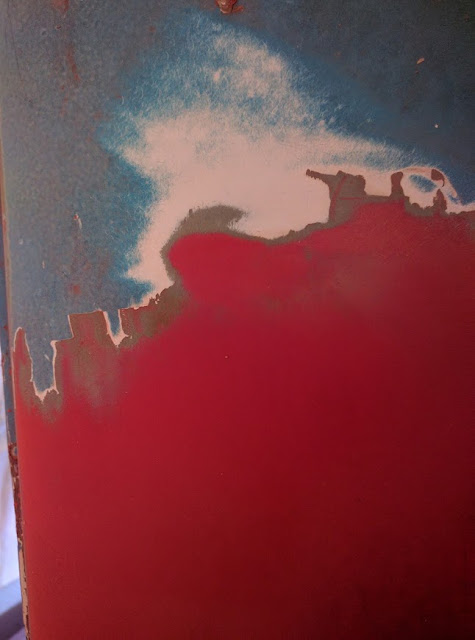
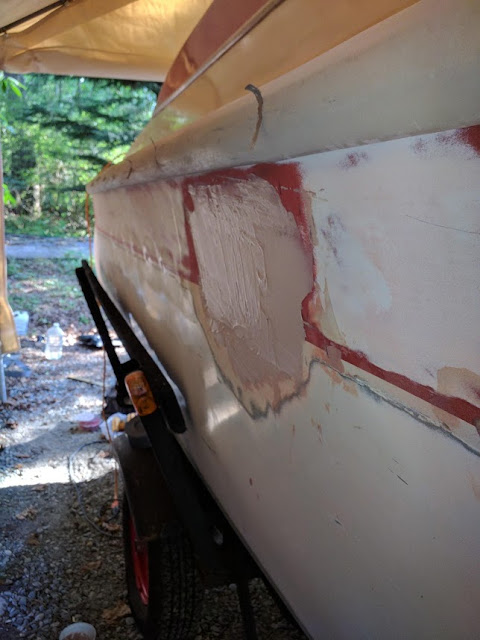
Painting Now that the rebuild of the stern is complete the Offshore is ready to get on the water! Of course it's lacking a motor and looks like crap, but theoretically I could launch and paddle around! At some point I also need to get the boat off the trailer, clean up the latter, and have it inspected by Washington State Patrol so it can be licensed and legal. Haven't figured out the best way to do that, but will soon. Good preparation is the key to a successful paint job, so because the paint is so old it is necessary to strip it all off, down to the gel coat. There were three coats of paint: gray primer, white, then blue on the trim. All of the coats were sprayed, probably using enamel paint. Not having any history of the boat I can only guess this was done in the 80s or maybe earlier, based on the pervasive fading. Partially sanded side deck showing three coats of paint over the original red gel coat. I've been stripping the old paint off the topsides using a...
Image
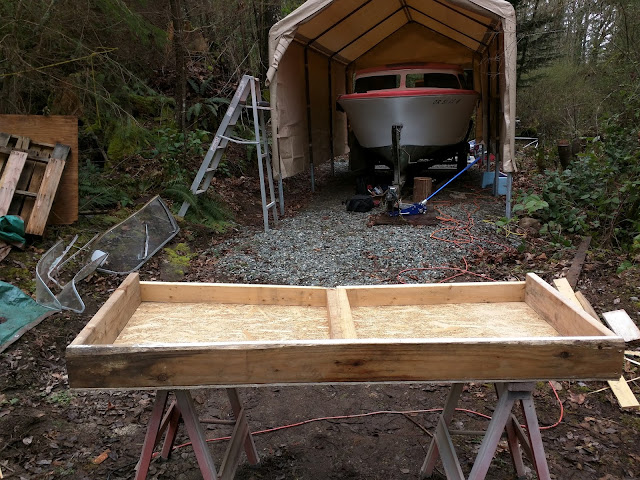
Splash Well Shelf After completing the transom, the last task for restoring the aft portion of the Offshore was to rebuild the splash well. Most reading this probably know about this feature of outboard boats, but I wasn't real familiar with it. If I understand it correctly, when you slow down, especially coming off a plane, the wake (wave) catches up to the boat and you can get water over the transom. If you don't have a splash well this water would go into the bilge, which you could either pump out or open the drains when the boat is under way to let gravity and vacuum expel it. The well is self draining.  Remnants of the port (top) and starboard splashwell shelf when I got the boat. The shelf rests on cleats installed on the bulkhead and transom. One could also put cleats along the side, but the factory didn't do this; instead they tabbed the shelf onto the bottom of the vertical stiffeners you see in the above pictures. I did the same, because the s...